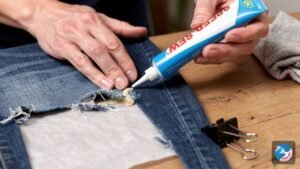
To remove dried fabric glue without damaging the fabric, soften the glue before you try to lift it. Identify the type of glue if you can, check the garment’s fibre content, and test your method on a hidden spot. Then work from gentlest to strongest: warm water and dish soap first, then rubbing alcohol, and acetone only on fabrics that can handle it. Hot glue is different. You can freeze it until it is brittle, or warm it and blot it onto paper. Lift the softened glue slowly with a dull edge, and keep the item out of the dryer until all the residue is gone. Heat can set what is left and make it harder to remove.
The rest of this guide explains how to choose a method, which fabrics need extra care, and what to do if the glue was a repair you plan to redo.
- Soften glue before lifting it, and work from gentlest to strongest: warm soapy water, rubbing alcohol, then acetone only where the fabric allows it.
- Never use acetone on acetate, triacetate or modacrylic, and spot-test every remover in a hidden area.
- Air dry between attempts, because dryer heat can set leftover residue.
Why dried glue is hard to remove, and what damage looks like
Fabric glue is made to sink into the weave and grip the fibres. That is what makes a glued hem or patch hold, and it is also why scraping or peeling dried glue tends to cause problems. When glue that is still hard gets pulled off, it can take fibres with it. You can end up with a thin or fuzzy patch, pulled threads, or a small hole.
Damage can also come from the remover. These are the main risks:
- Fibre damage: strong solvents can dissolve or weaken some synthetic fibres.
- Colour loss: solvents and hard rubbing can lift dye and leave a pale spot.
- Shine or texture change: heat or scraping can flatten pile fabrics such as velvet and corduroy, or leave a glossy patch.
- Rings: dissolved glue can spread outward and dry as a faint outline around the original spot.
Each method below is designed to avoid these problems. It works by softening the glue so it lets go of the fibres, and then lifting it away gently.
Step one: figure out what kind of glue you are dealing with
The right remover depends on the glue’s chemistry. Getting this right first saves you from trying several solvents on one spot.
If you still have the bottle
Read the label for clean-up instructions. If it says to clean up wet glue with soap and water, the glue is probably water-based. Warm water is the place to start. If the label lists a solvent for clean-up, or warns about flammability and ventilation, the glue is probably solvent-based, and water alone may do little. Some labels include removal guidance. When the label is unclear, the manufacturer is the best source for that specific product. For Speed-Sew, the website lists hello@speed-sew.com as a contact.
If you don’t know what glue was used
This often happens with second-hand clothing, store-bought items, or repairs someone else made. Look and feel for clues:
- Clear and slightly rubbery or flexible: common with many fabric glues. Start with warm water, then try alcohol.
- White or cloudy and stiff: often a water-based craft or school glue. Warm water usually helps.
- Raised, shiny beads or strings: almost always hot glue from a glue gun. Use the freezing or heat-and-blot methods.
- A strong chemical smell, even after drying: may be solvent-based. Plan to test alcohol, then acetone if the fabric allows it.
If you can’t tell, work up the list from gentlest to strongest and test each step.
Before you start: check the fabric and test a hidden spot
Read the garment’s care label for fibre content and washing instructions. The fibre affects your method more than the glue does. A solvent that is harmless on cotton can ruin acetate. A dry-clean-only label suggests the fabric may not tolerate a long soak.
Test every remover on a hidden area first, such as an inside seam allowance, the back of a hem, or the underside of a pocket flap. Dab a little on with a cotton swab, wait a few minutes, and blot with a white cloth. Look for colour on the cloth, and for any change in texture, shine or stiffness on the fabric. If anything changes, don’t use that remover on a visible area.
Useful tools:
- Dish soap and a bowl or basin
- Cotton swabs and white cloths or paper towels
- A dull butter knife, an old credit card or a plastic scraper
- Tweezers for small bits
- Rubbing alcohol (isopropyl)
- Acetone or acetone-based nail polish remover, only if the fabric can handle it
- Brown paper or plain paper towels and an iron, for hot glue
- A freezer bag and ice, for hot glue or thick rubbery glue
Method 1: soak and soften with warm water (start here)
This is the gentlest method and the right first try for water-based glues and unknown glues on washable fabric. Order matters, so follow the steps in sequence.
- Scrape off any loose raised glue with a dull edge. Push gently and stop if the glue resists.
- Fill a basin with warm water, as warm as the care label allows, and add a squeeze of dish soap.
- Submerge the glued area and let it soak. Thick or old glue may need a long soak, so check it periodically instead of setting a fixed time.
- Test the edge of the glue with a fingernail or dull knife. When it feels soft, gummy or turns cloudy, it is ready.
- Work from the back of the fabric where possible and roll or push the glue toward its edge. Don’t pull straight up. Rolling lifts the glue off the fibres instead of dragging fibres up with it.
- Put the item back in to soak if the glue hardens again, and repeat.
- Wash the item as the care label directs. Let it air dry and check for residue before using any heat.
Patience works better than force with this method. Several shorter rounds of soaking and gentle lifting are better than one aggressive scrape.
Method 2: rubbing alcohol for glue that water won’t move
Isopropyl rubbing alcohol softens many flexible and clear adhesives that barely react to water. It is generally gentler on fabric than acetone, but it can still lift some dyes, so do a spot test first.
- Put a folded white cloth or paper towel under the glued area so softened glue moves into it and doesn’t spread.
- Dampen a cotton swab or cloth with alcohol and dab it onto the glue. Don’t flood the area, because extra liquid can carry dissolved glue outward and leave a ring.
- Give it a few minutes to work, then test the edge.
- Lift softened glue with a dull edge or tweezers. Blot often, and switch to a clean part of the cloth so you don’t press glue back in.
- Repeat as needed, then wash or rinse the area to remove the alcohol and any loosened residue.
Work from the outside of the spot toward the centre. This keeps the glue from spreading and reduces the chance of a ring.
Method 3: acetone, only on fabrics that can take it
Acetone is the strongest common household option and can soften stubborn solvent-type adhesives. It is also the remover most likely to damage fabric.
Do not use acetone on acetate, triacetate or modacrylic. Acetone can dissolve these fibres and leave a hole or a melted, stiff patch. Some linings, evening wear and older garments contain acetate, so read the fibre content carefully. If the label is missing or unclear, skip acetone or test it somewhere you would not mind losing.
Acetone can also strip dye, especially on bright or dark colours. On fabrics that tolerate it, such as many cottons, linens and polyesters, use the same dab-and-blot technique as with alcohol. Use a small amount, put a cloth underneath, and wash the item soon afterward. Nail polish remover can also work, but some formulas contain added oils or dyes. Choose a plain, clear one and test it.
Method 4: hot glue needs a different approach
Hot glue is a thermoplastic. It softens with heat and becomes brittle when cold, and water and alcohol do little to it. You have two options.
Freeze and crack
Put the item in a freezer bag in the freezer, or hold a bag of ice against the glue until it is thoroughly cold. Flex the fabric gently, and the glue may crack or pop off. Pick off the pieces with your fingers or tweezers. This avoids heat, so it is a good first try on synthetics that might melt. It works best on raised blobs sitting on top of the fabric, and less well on glue that has soaked into a loose weave.
Heat and blot
Put brown paper or a plain paper towel on top of the glue and another layer underneath. Press briefly with a warm iron set to the lowest temperature that softens the glue, and never higher than the care label allows. The melted glue should move into the paper. Move to a fresh section of paper and repeat. This is risky on delicate synthetics, which can melt, mark or go shiny under an iron. Test on a hidden area, and use the freezing method on those fabrics.
Method 5: commercial adhesive removers
Citrus-based and other commercial adhesive removers can work on stubborn residue. They often leave an oily film, which can turn into its own stain if it is not washed out. If you use one, check that the product label says it is suitable for fabric, test it in a hidden spot, use as little as possible, and pre-treat the area with dish soap before washing to break down the oil.
Fabric-by-fabric guide
Use this table as a starting point. Fibre content and dye vary between garments, so the spot test still comes first.
| Fabric/material | Best method to try first | Key warning |
|---|---|---|
| Denim/cotton | Warm soapy soak, then alcohol; acetone if needed | Dark denim can lose dye with solvents and hard rubbing |
| Linen | Warm soapy soak | Loose weaves let glue sink deep, so expect several rounds |
| Stretch fabric (spandex blends) | Warm soak, gentle alcohol dabbing | Heat and strong solvents can damage elastic fibres |
| Delicate synthetics (polyester, nylon) | Test first; freezing for hot glue | Heat from an iron can melt or mark the surface |
| Acetate, triacetate, modacrylic | Water only, or take it to a professional | Acetone can dissolve the fibres |
| Wool | Lukewarm soak with gentle soap, minimal handling | Hot water and agitation can cause felting or shrinking |
| Silk | Professional cleaning is the safer choice | Water spots, dye loss and texture change are common risks |
| Velvet, corduroy, pile fabrics | Soften and lift from the back | Scraping or ironing flattens the pile |
| Leather/vinyl | Check the material maker’s guidance | Solvents and heat can damage the surface finish |
Dealing with leftover rings, stiffness and shine
Once most of the glue is gone, a faint outline or a stiff patch may remain.
- Rings: dampen the whole area evenly, slightly beyond the ring, so it dries without a hard edge. Then wash the item normally.
- Stiffness: a thin layer of residue is usually left in the fibres. Do another soak or alcohol round, then wash. Working the area gently between your fingers while it is damp can help loosen it.
- Shine: this usually comes from heat or pressure, not glue. On pile fabrics, steam held just above the surface can sometimes lift flattened fibres. On flat-weave synthetics, heat shine may be permanent.
Let the item air dry after each attempt. If you put it in the dryer while residue remains, the heat can make that residue harder to remove.
When to stop and take it to a professional
Some situations are better handled by a dry cleaner or a textile specialist:
- The garment is silk, acetate, or labelled dry-clean only.
- The glue covers a large area on a visible part of an expensive or sentimental item.
- Your spot test showed colour transfer or a texture change.
- Two or three gentle rounds haven’t softened the glue at all.
Tell the cleaner what kind of glue it is, if you know, and what you have already tried. This helps them choose a safe approach. They can’t guarantee complete removal either, especially if the glue has been through a hot dryer.
If you’re removing glue to redo a repair
Glue is often removed because a repair came loose or ended up in the wrong place. Before you redo the repair, consider whether glue is the right fix for that spot.
When not to use fabric glue
Sewing is the better choice for:
- High-stress seams such as the crotch, backpack straps and other load-bearing areas
- Large holes where fabric is missing, which need a patch or darning
- Expensive garments where an invisible repair matters
- Children’s clothing that gets rough play
- Stretch denim that needs as much flexibility as possible
- Belt loops, pocket openings and seam junctions
If the original repair failed in one of these areas, the glue may not have been at fault. The spot may simply ask more of an adhesive than it can give.
Care checklist for a glued repair
If glue is right for the repair, these steps reduce the chance of having to remove it again:
- Make sure all old residue is gone and the fabric is clean and dry before you reapply.
- Apply a thin, even layer. Glue that is too thick can’t cure properly.
- Press firmly for 30 to 60 seconds.
- Remove any excess before it dries. Wet glue is much easier to clean up than dried glue.
- Cure for 24 to 72 hours before washing.
- Wash inside out on a gentle cycle.
- Avoid high dryer heat, and check the garment label.
- Test on a scrap of fabric first if you’re unsure.
Safety while you work
Rubbing alcohol, acetone and many commercial removers are flammable and give off fumes. Work in a well-ventilated room away from open flames and heat sources. Use small amounts, and keep containers closed when you’re not using them. Gloves help protect your skin from repeated solvent contact. Let solvent-dampened cloths dry outdoors or throw them away safely, and don’t leave them in a pile. Check the product label for safety guidance, especially for children’s clothing or when children are helping with the craft. Keep solvents out of reach of children while you work.
Can I put a garment in the dryer to help loosen dried glue?
No. Let the item air dry after each removal attempt. Dryer heat can set leftover residue and make it harder to remove. Use heat only deliberately, as in the heat-and-blot method for hot glue, and only on fabrics that tolerate it.
Is nail polish remover safe to use instead of pure acetone?
It can work, but some formulas contain added oils or dyes. Choose a plain, clear one and test it on a hidden spot. Like acetone, it should not be used on acetate, triacetate or modacrylic, and it can strip dye from some fabrics.
What if I don’t know what kind of glue was used?
Look for clues. Raised shiny beads usually mean hot glue, white stiff glue is often water-based, and a lingering chemical smell may mean a solvent-based glue. If you can’t tell, start with a warm soapy soak, then try rubbing alcohol, then acetone only if the fabric allows it. Test each one in a hidden area first.
Last updated: 1 November 2026